Friday, November 2, 2018

VIDEO-ON-DEMAND SERVICES EXPECTED TO INVEST UP TO US$10.1B (RM42.4B) IN ASIA BY 2022

Local demand will result in greater investment in Asian storytelling and production
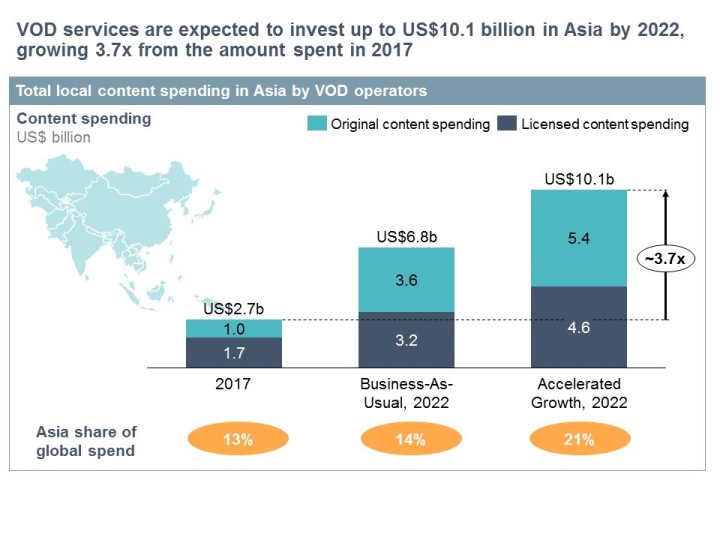
KUALA LUMPUR, Nov 1 (Bernama) — According to a report released today by strategy and economics consulting firm AlphaBeta, titled “Asia-On-Demand: The Growth of Video-on-demand Investment in Local Entertainment Industries,” video-on-demand (“VOD”) services are expected to invest up to US$10.1 billion (RM42.4 billion)  in Asia by 2022, growing 3.7x from the amount spent in 2017. The study also found that Asian consumers of VOD services continue to show a strong appetite for local content; prompting industry players to focus on becoming more locally relevant.
VODSERVICES
Around US$4 billion of this expected investment will be in the form of foreign direct investment by global players. Additionally, the economic impact VOD players will have is expected to be more than 3x the amount spent on investment. This is especially when considering direct spending within the industry on core operations (e.g. equipment, transport, catering, marketing, hospitality, etc.), which in turn drives indirect spending by suppliers (e.g. camera lenses, catering, transport fuel, etc.), and induced spending from workers employed spending their wages in the economy. Up to 736,000 jobs could also be created by this spending in 2022; and there may be spillover benefits to other industries, such as tourism, music, or merchandised products.
At the same time, the study found that the number of paying subscribers in Asia is expected to double in five years, and that viewers in Asian countries have a strong appetite for high quality local content. To meet this growing demand, VOD services will have to become more locally relevant; driving investment to develop more high quality local content to attract and retain subscribers.
Commenting on the report, Konstantin Matthies, AlphaBeta Engagement Manager said, “Given its nascency, the economic impact of VOD services in Asia – particularly in the entertainment industry – has received limited attention to date. This research aims to fill this gap by providing a fact base on the industry’s potential value. The report further identifies best practices, alongside key policy actions to ensure Asian countries can capture this opportunity.”
He added, “As the VOD industry grows in Asia, demand for locally relevant content will drive players to spend a meaningful part of this investment in stories from the region. This is contrary to perceptions that VOD’s easy access to foreign (i.e. Hollywood) content would reduce local demand and dilute cultural values. With strong consumer demand for local content, VOD players will have to increasingly provide high-quality local content to align with these preferences.”
Local demand will result in greater investment in Asian storytelling and production
 
KUALA LUMPUR, Nov 1 (Bernama) -- According to a report released today by strategy and economics consulting firm AlphaBeta, titled “Asia-On-Demand: The Growth of Video-on-demand Investment in Local Entertainment Industries,” video-on-demand (“VOD”) services are expected to invest up to US$10.1 billion (RM42.4 billion)  in Asia by 2022, growing 3.7x from the amount spent in 2017. The study also found that Asian consumers of VOD services continue to show a strong appetite for local content; prompting industry players to focus on becoming more locally relevant.

Around US$4 billion of this expected investment will be in the form of foreign direct investment by global players. Additionally, the economic impact VOD players will have is expected to be more than 3x the amount spent on investment. This is especially when considering direct spending within the industry on core operations (e.g. equipment, transport, catering, marketing, hospitality, etc.), which in turn drives indirect spending by suppliers (e.g. camera lenses, catering, transport fuel, etc.), and induced spending from workers employed spending their wages in the economy. Up to 736,000 jobs could also be created by this spending in 2022; and there may be spillover benefits to other industries, such as tourism, music, or merchandised products.
 
At the same time, the study found that the number of paying subscribers in Asia is expected to double in five years, and that viewers in Asian countries have a strong appetite for high quality local content. To meet this growing demand, VOD services will have to become more locally relevant; driving investment to develop more high quality local content to attract and retain subscribers.
 
Commenting on the report, Konstantin Matthies, AlphaBeta Engagement Manager said, “Given its nascency, the economic impact of VOD services in Asia - particularly in the entertainment industry - has received limited attention to date. This research aims to fill this gap by providing a fact base on the industry’s potential value. The report further identifies best practices, alongside key policy actions to ensure Asian countries can capture this opportunity.”
 
He added, "As the VOD industry grows in Asia, demand for locally relevant content will drive players to spend a meaningful part of this investment in stories from the region. This is contrary to perceptions that VOD’s easy access to foreign (i.e. Hollywood) content would reduce local demand and dilute cultural values. With strong consumer demand for local content, VOD players will have to increasingly provide high-quality local content to align with these preferences.” 
 
The report outlines seven key findings:

1.  Video-on-demand (VOD) services are expected to invest up to US$10.1b in Asia by 2022. 
Globally, VOD operators spent around US$21 billion in 2017 and while Asia accounted for only around US$2.7 billion in content spending in 2017, this could rise by 3.7x by 2022. Around US$4 billion of this spending is in the form of foreign direct investment by global players.

2.  Demand for local content will drive investment, with an emphasis on quality over quantity. 
Contrary to common belief, viewers in Asian countries have a strong appetite for local stories and spend equal time watching local and foreign content. With paying subscribers in Asia expected to double over five years, VOD services will need to focus on producing high-quality local content to attract and retain consumers.
 
3.  VOD makes it easier for Asian entertainment to reach over 450 million people globally.  
VOD services are enabling the dissemination of Asian content to wider audiences abroad. For example, the TV series “Sacred Games” from India was watched online by viewers in over 190 countries. This can potentially drive cultural influence and demand for Asian exports, including tourism.
 
4.  The economic impact is expected to be 3x the amount VOD players spend on content. 
Direct spending within the industry on core operations (e.g. equipment, transport, catering, marketing, hospitality, etc.) in turn drives indirect spending by suppliers (e.g. camera lenses, catering, transport fuel, etc.), and induced spending from workers employed spending their wages in the economy. Up to 736,000 jobs could also be created by this spending in 2022. Finally, there are spillover benefits to other industries, such as tourism, music, merchandized products, etc.
 
5.  Further benefits to local industry could be realized in the form of financing production hubs, skills upleveling, low-cost distribution, and global partnerships. 
The benefits that VOD players provide to the local industry is not just through their content spending. They build local skills and introduce new technology. The ability of VOD operators to broker partnerships between local and international players can also be crucial in raising the international appeal of local content, as well as enabling knowledge transfer.
 
http://mrem.bernama.com/viewsm.php?idm=33132

Thursday, November 1, 2018

CHIBA GOVERNOR KENSAKU MORITA TO VISIT SINGAPORE

CHIBA GOVERNOR KENSAKU MORITA TO VISIT SINGAPORE

BUDGET 2019 TO PROPEL MALAYSIA'S SMES AND ENTREPRENEURS TO GREATER HEIGHTS

KUALA LUMPUR, Nov 1 (Bernama) -- The 2019 Budget, to be tabled on Friday, is expected to be an inclusive and rakyat-friendly one which is set to benefit the Malaysians while providing a growth stimulus towards the economy, said Nitesh Malani, Chairman of Yayasan Usahawan Malaysia (MyPreneurship).

The maiden Pakatan Harapan budget which is to be presented by Finance Minister Lim Guan Eng would contribute to the creation of an ecosystem that would help the economy improve & progress towards the vision 2020 set by Prime Minister Tun Dr. Mahathir Mohamad.

MyPreneurship, a non-government organisation strives on the frontier of gathering, creating and developing sustainable companies with strong entrepreneurship traits, and has been in the forefront of supporting Malaysia’s entrepreneurship development.

“Entrepreneurship is one of the main drivers of the country’s economic growth in which it creates wealth, innovation and technology deployment while reducing poverty,” says Nitesh. “We hope that the tabling of Budget 2019 will have a special focus on programs and policies that have been formulated to spur the development of entrepreneurs.”

MyPreneurship’s treasurer, Tom Wong quips that various incentives should be given to the SMEs and entrepreneurs as the industry contributes an excess of 80% towards the GDP of the country. Tom Wong is also the CEO of Cheng & Co., Malaysia’s leading home-grown international accounting firm.

“Tax incentives for capital investment into SMEs by people on the street thru fintech should be considered as the current tax incentive is available for angel or private equity investors,” he added. “We also hope the government will defer the introduction of digital tax and instead provide incentives or soft loans so that the e-commerce industry in Malaysia can benefit more.”

http://mrem.bernama.com/viewsm.php?idm=33127

Singapore first in South-East Asia to introduce standardised tobacco packaging

KUALA LUMPUR, Nov 1 (Bernama) -- Singapore will be first country in South-East Asia to introduce standardised packaging for tobacco, according to Australia's leading cancer charity, Cancer Council Australia.

The Council in a statement has congratulated the move by the Singaporean Ministry of Health to introduce standardised packaging and enlarged health warnings on tobacco products.

The new regulations to be applied on tobacco products sold in Singapore include size of mandatory graphic health warnings to be increased from the existing 50 per cent to cover 75 per cent of the packaging surface and all products will be required to be free from logos, colours, brand images and promotional.

Tobacco use is a major health issue in Singapore, despite its long history of strong tobacco control measures. More than 2,000 Singaporeans die prematurely from smoking-related diseases annually and one in five men in Singapore smoke daily, a statement said.

Chair of Tobacco Issues Committee, Cancer Council Australia, Paul Grogan said in 2012, Australia became the first country in the world to introduce standardised or plain packaging and since then, it has exceeded expectations in reducing smoking rates.

“In its first three years, plain packaging contributed to a 25 per cent reduction in smoking rates in Australia and we hope that through these new measures Singapore will be able to achieve similar results,” added Grogan.

These measures are also in line with Singapore's obligations as a party to the WHO Framework Convention on Tobacco Control.

Singapore Health Promotion Board and Ministry of Health should be commended for promoting a comprehensive set of supporting measures to support standardised packaging such as tobacco tax, cessation support and advertising bans, the council said.

Countries in South-East Asia are welcomed to take Singapore's lead and introduce similar reform. Other countries to already adopt similar standardised packaging measures include France, the United Kingdom, Norway, Ireland, New Zealand and Hungary.

--BERNAMA

Ljubisav Matejevic to lead Ascom's strategic partners worldwide


KUALA LUMPUR, Nov 1 (Bernama) -- Ascom Holding AG --  a global solutions provider focused on healthcare ICT and mobile workflow solutions -- has appointed Ljubisav Matejevic to continue the growth with strategic partners around the world.

Ascom’s strategic partners includes medical device manufacturers and global system integrators, value added resellers, electronic medical record companies, independent software vendors and leading healthcare consultancies, a statement said.

Matejevic has been working with Ascom since September 2017 as Vice President Global Ecosystem and Central and Eastern Europe as well as President of the Global Clinical + Care Coordination Forum (GCCCF).

He has over 25 years of market and business development experience and a profound expertise in thought leadership. As Global Market Development and Strategy Executive, Matejevic represented IBM’s Global Healthcare and Life Sciences Business (HCLS).

As the Global Alliance Executive for Healthcare & Life – Science and Public Health, Matejevic also managed the independently founded Global E-Health Forum to generate and strengthen cooperation across IBM’s strategic partners and important stakeholders.

Ascom headquartered in Baar (Switzerland) has operating businesses in 18 countries. The company’s mission is to provide mission-critical, real-time solutions for highly mobile, ad hoc and time-sensitive environments. More details on https://www.ascom.com.

-- BERNAMA

MATA EMPOWERS BLIND AND VISUALLY IMPAIRED COMMUNITY

KUALA LUMPUR, Oct 30 (Bernama) – Growing up with a grandmother who was visually impaired and having a blind classmate inspired Muhamad Faizal Lockman Hakim, 35, to start MATA, the sunglasses brand under a social entrepreneurship company to empower the blind and visually impaired community in Malaysia.
Known as Mamu to his family and friends, Muhamad Faizal started MATA through the Community Based Rehabilitation (CBR) outreach programme under the Malaysia Association for the Blind (MAB) to assist the poor and rural blind.

“MATA is funded by SME Corp. Malaysia and managed by Yayasan Inovasi Malaysia (YIM). They allocated RM200,000 as a grant for this project and we contribute 20 percent of every purchase to the MAB”, he told reporters after the launch of ‘MATA – Eyewear For A Noble Cause’ here today.

Muhamad Faizal said MATA’s first model is the ‘Blackout’ edition which has been tested in different settings such as under bright lighting and while driving.

“Our material for the sunglass is unbreakable and you can actually bend it, while the lens has an anti-scratch feature. We have also customised the material to cater for Asian usage and weather. We target up to 1,000 sunglasses to be sold by the end of the year,” he said.

Muhamad Faizal also has plans to produce ‘smart talking glasses’ in four years.

These glasses are able to detect obstacles with the help of a sensor and notify the user through headphones and vibration motors.

Meanwhile, Deputy Chief Executive Officer (CEO) I, SME Corp. Malaysia Rizal Nainy said the MATA was developed with government assistance through the High Impact Programme 6: Inclusive Innovation (HIP 6) under the SME Masterplan (2012-2020).

The sunglasses are now available for purchase on www.mata.vison website.

-- BERNAMA